

The mechanical properties of 7 µm thick Ti-CP (grade 1) foils with ultra-fine grains were studied through tensile tests at 25, 100, 200 and 300 °C and creep tests at 300 °C.
Microstructure evolution was analyzed by X-ray diffraction (XRD) at the same temperatures. Results revealed size effects linked to the thickness-to-grain ratio (t/D).
Due to nanometric grains, yield stress (YS) and ultimate tensile strength (UTS) are higher than in bulk material, while total elongation (AR%) is lower.
Strain heterogeneity occurred because surface grains deform more easily than inner ones. In creep tests under stresses up to 185 MPa, samples showed initial contraction instead of elongation.
This anomaly was explained by the combined influence of strong prismatic texture and gas atom absorption (O and N), which occupy octahedral, hexahedral, and crowdion sites in the hcp lattice.
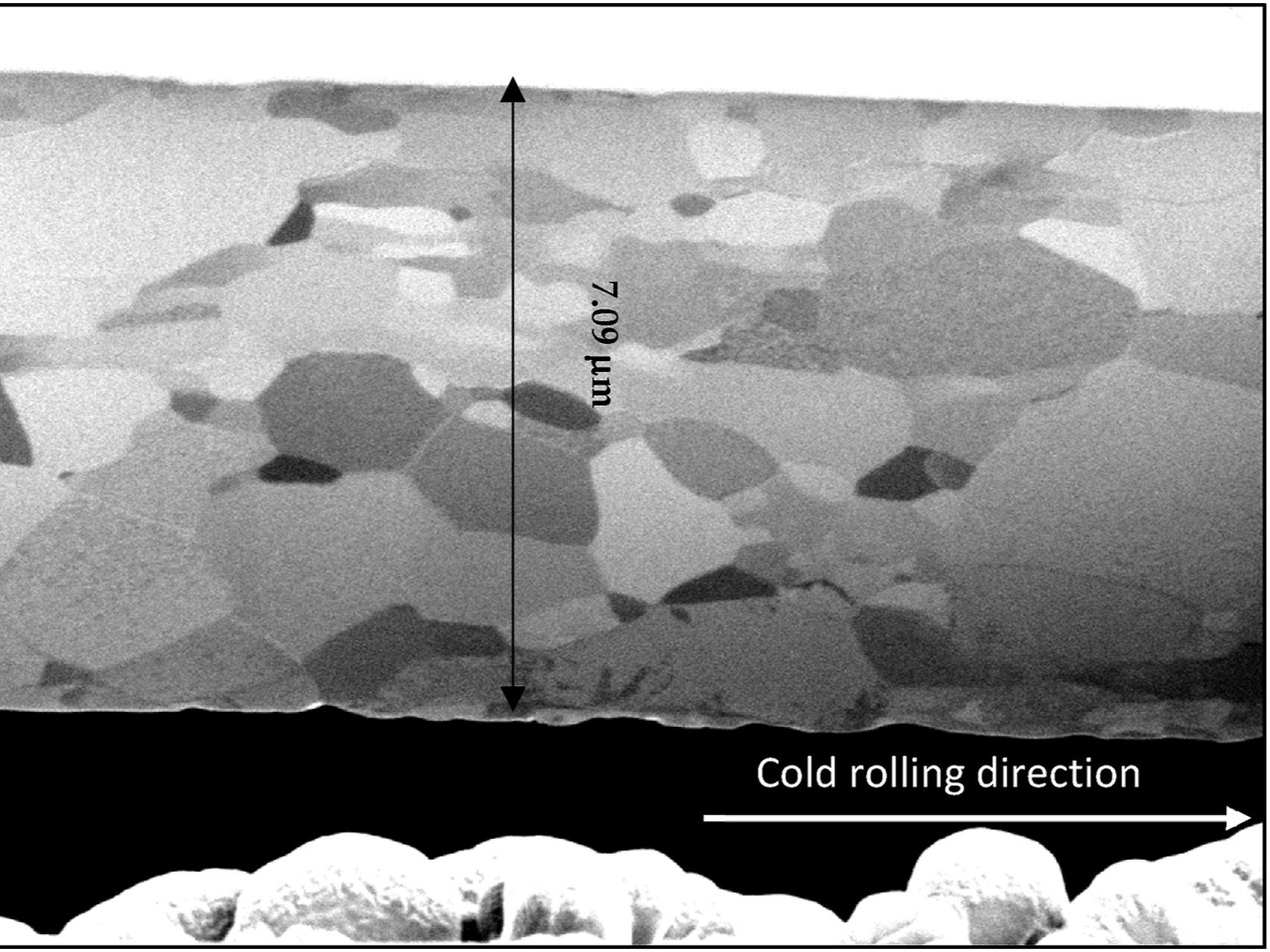 Cross-section of a Ti-CP sample after the heat treatment at 450 °C for 1800 s.
Commercially pure titanium (Ti-CP) foils represent an advanced material solution designed for sectors requiring lightweight, high-strength, and corrosion-resistant components.
These foils, with ultra-thin thickness (~7 µm) and ultra-fine grains, offer superior mechanical performance compared to conventional titanium grades, thanks to optimized microstructure achieved through severe plastic deformation and heat treatment.
Ti-CP foils are intended for industries such as aerospace, energy, and medical technology, where reliability under demanding conditions is critical.
Their unique properties—low density, high specific strength, and excellent resistance to oxidation—make them suitable for environments involving thermal and mechanical stress.
The product is engineered to overcome limitations of traditional titanium sheets, such as poor wear resistance and creep strain at intermediate temperatures, by leveraging grain refinement and controlled texture to enhance strength and stability.
This innovation ensures improved formability and durability, enabling integration into complex designs and high-performance systems.
Ti-CP foils achieve far higher strength than conventional Ti-Grade 1 thanks to ultra-fine grains and extreme thinness, introducing size-effect advantages. Unlike bulk Ti, these foils exploit Hall-Petch strengthening and interstitial oxygen for superior YS and UTS. The innovative dual-layer deformation model and texture-controlled anisotropy represent a significant improvement over traditional homogeneous materials.
Unlike prior models assuming octahedral-only occupancy, this study reveals oxygen diffusion through multiple interstitial sites (hexahedral, crowdion), altering lattice parameters and explaining creep anomalies. This insight improves understanding of Ti behavior under stress and temperature, enabling better control of microstructure for advanced applications compared to conventional creep models.
Ti-CP alloys, valued for low density, high strength, and corrosion resistance, are widely used in medical devices, prostheses, and hydrogen separation membranes. Ultra-thin Ti-CP foils enable advanced applications in desalination plants, gas turbine engines, centrifuges, heat exchangers, condensers, and aerospace or marine sectors for electronic shielding and camera shutters. They also serve in critical components like satellite fuel tanks and nuclear waste containers.
 Thin cold-rolled Ti-CP for aerospace and defence applications. (https://www.aerospacemanufacturinganddesign.com/product/arnold-thin-rolled-titanium-foils-alloys/)
Ultra-Thin Ti-CP Foils for Aerospace and Defence Components.
Thin cold-rolled Ti-CP foils are employed in aerospace and defence for lightweight structural components, thermal shielding, and precision parts, ensuring superior strength, corrosion resistance, and reliability under extreme conditions.
Ti-CP ultra-thin foils were tested under tensile and creep conditions to evaluate their mechanical behavior at different temperatures. Tensile tests at 25–300 °C revealed that yield stress (YS) and ultimate tensile strength (UTS) decrease with temperature, while elongation (AR%) increases. At room temperature, YS ≈ 444 MPa and UTS ≈ 499 MPa, confirming superior strength compared to conventional Ti-Grade 1. Fracture analysis showed heterogeneous deformation: a thin surface layer exhibited ductile slip bands, while the inner zone fractured in brittle mode. Creep tests at 300 °C under stresses of 160–208 MPa highlighted an anomalous contraction phase at lower stresses before normal elongation resumed; failure occurred only at 208 MPa. XRD measurements demonstrated lattice expansion and texture evolution with temperature, with prismatic [200] orientation strengthening up to χ = 50 at 300 °C. After creep, partial grain rotation (~60°) was observed, indicating microstructural adaptation under load. These results confirm that Ti-CP foils combine high strength with controlled anisotropy, making them suitable for demanding thermal and mechanical environments.
Il Sentiero International Campus; University of Rome Tor Vergata; Tetra Pak Packaging Solutions AB; Consorzio CALEF c/o ENEA CR Casaccia
Application of commercially pure Ti-CP in ultra-thin foils is expanding due to its low density, high strength, and corrosion resistance. Research focuses on improving mechanical properties through grain refinement and severe plastic deformation, enabling advanced uses in aerospace, medical devices, and energy sectors. Tests assess tensile and creep behavior to optimize formability and performance.
 Creep curves at 160, 185 and 208 MPa (a). Detail of the initial contraction of samples tested at the lower stresses